Inside Amp Code: How Sourcegraph is Building AI-Powered Development
 Isaac FlathAugust 20, 2025
AI coding assistants are changing how developers work. Sourcegraph's Amp Code aims to lead this shift. I interviewed Sourcegraph CEO Quinn Slack about Amp's multi-model architecture, team collaboration, and path to becoming the "best coding agent" [04:07]. We covered how Amp tackles development challenges and how it performed against Claude Code.
Two points we didn't cover:
-
Amp builds community. It offers free credits to students in our upcoming AI coding course and supports OSS creators.
-
Amp supports open-source developers. While I receive no credits, Amp supports my friends Danny and Audrey, who are building air, a new FastAPI framework.
Interview Introduction
I asked Sourcegraph CEO Quinn Slack how Amp Code differs from tools like Claude Code. My interest began when:
- Amp felt smooth on an OSS task.
- I compared it to Claude Code to rule out luck.
- Bryan mentioned Amp struggled with infrastructure, so I tested it.
- Amp produced better results, and I needed to know why.
- I spoke with the team.
Amp's Positioning
Why build Amp Code when other agents exist?
"We built AMP Code because we felt that it needed to exist. There's
nobody building anything like it that was trying to be the best
coding agent unconstrained in every way." - Quinn [04:07]
Sourcegraph started with code search before adding AI assistance. The shift shows their vision for the future of coding [04:33].
They believe they can stay focused, free from the business pressures competitors face. The Claude Code team, for instance, might hesitate to use a superior non-Anthropic model like GPT-5. Such flexibility is crucial in the fast-moving AI field.
The Multi-Model Advantage
"There's so many models being used under the hood right now, and
that's only going to grow," - Quinn [31:53]"AMP automatically selects the best model for the job, without
requiring the user to choose from a clunky dropdown menu manually. The
goal is simplicity for the user" - Quinn [11:26]."For the same price, you can have it scan through a lot more of your
code and then present the files that might be relevant to the main
smarter model for further investigation," - Quinn [30:36]
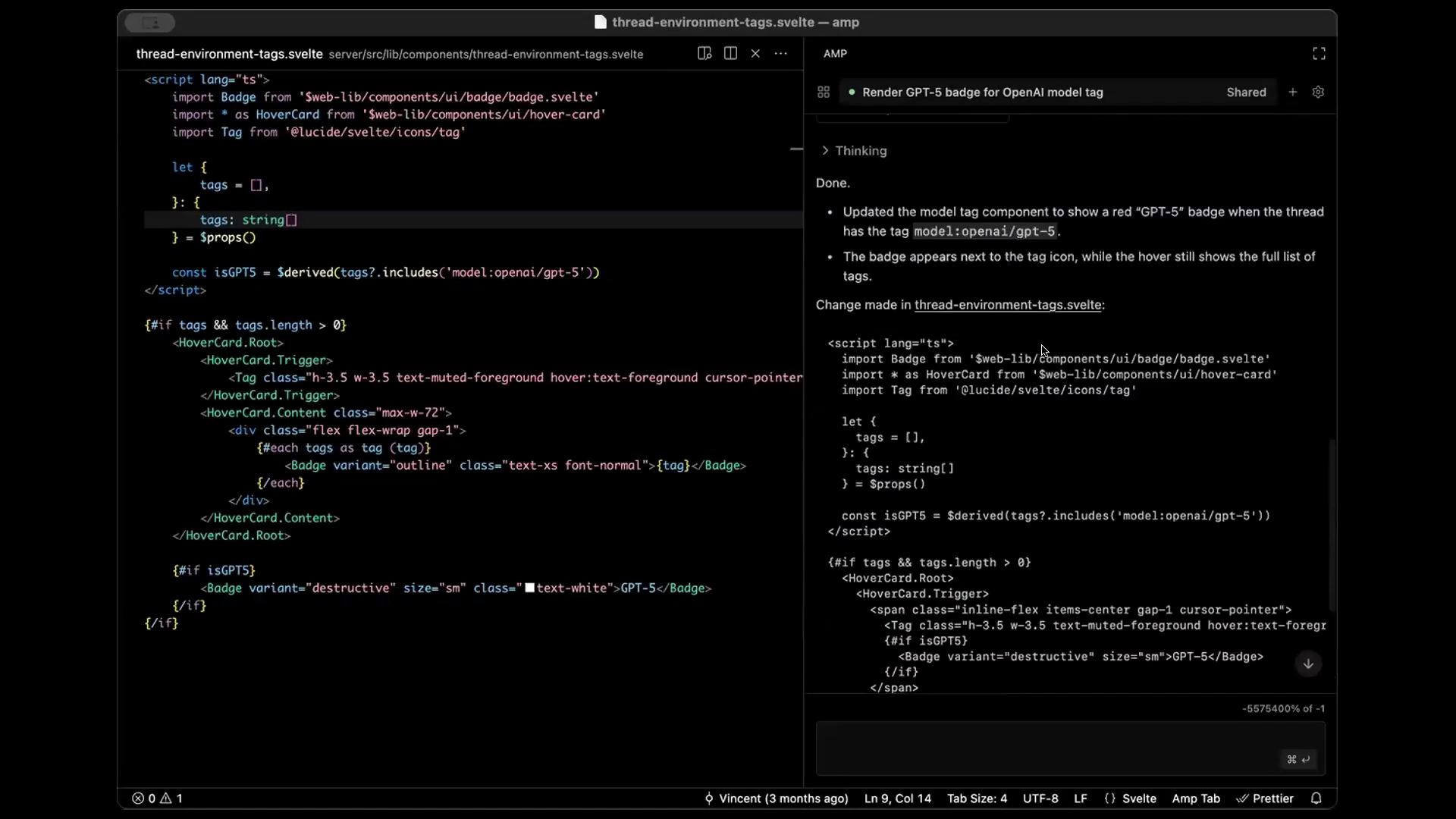
Amp Code's multi-model architecture sets it apart. Instead of one model, Amp uses several, each for a specific task.
The "Oracle" feature exemplifies this. It applies a powerful model to complex problems. Users can request the Oracle directly [26:45], or Amp can switch to it automatically for difficult tasks [26:54]. Amp currently uses O3 models but will adopt GPT-5 or another if it proves superior [28:46].
Quinn stressed that swapping models is difficult. Weeks of testing may not prove a change is better. The team does more than swap providers. They re-engineer the entire stack, from tool calling to URI displays. While they watch leaderboards, detailed trace notes offer the clearest insights.
This dynamic selection helps Amp optimize speed, cost, and accuracy.
Team Collaboration Features
"There's nothing like getting to see how the smartest people on your
team are using coding agents," - Quinn [09:57]
Quinn prioritized team collaboration, an early topic that reveals a company's focus. Amp's "multiplayer" features let developers learn from each other and share practices.
This improves upskilling, onboarding, and understanding the logic behind PRs and issues.
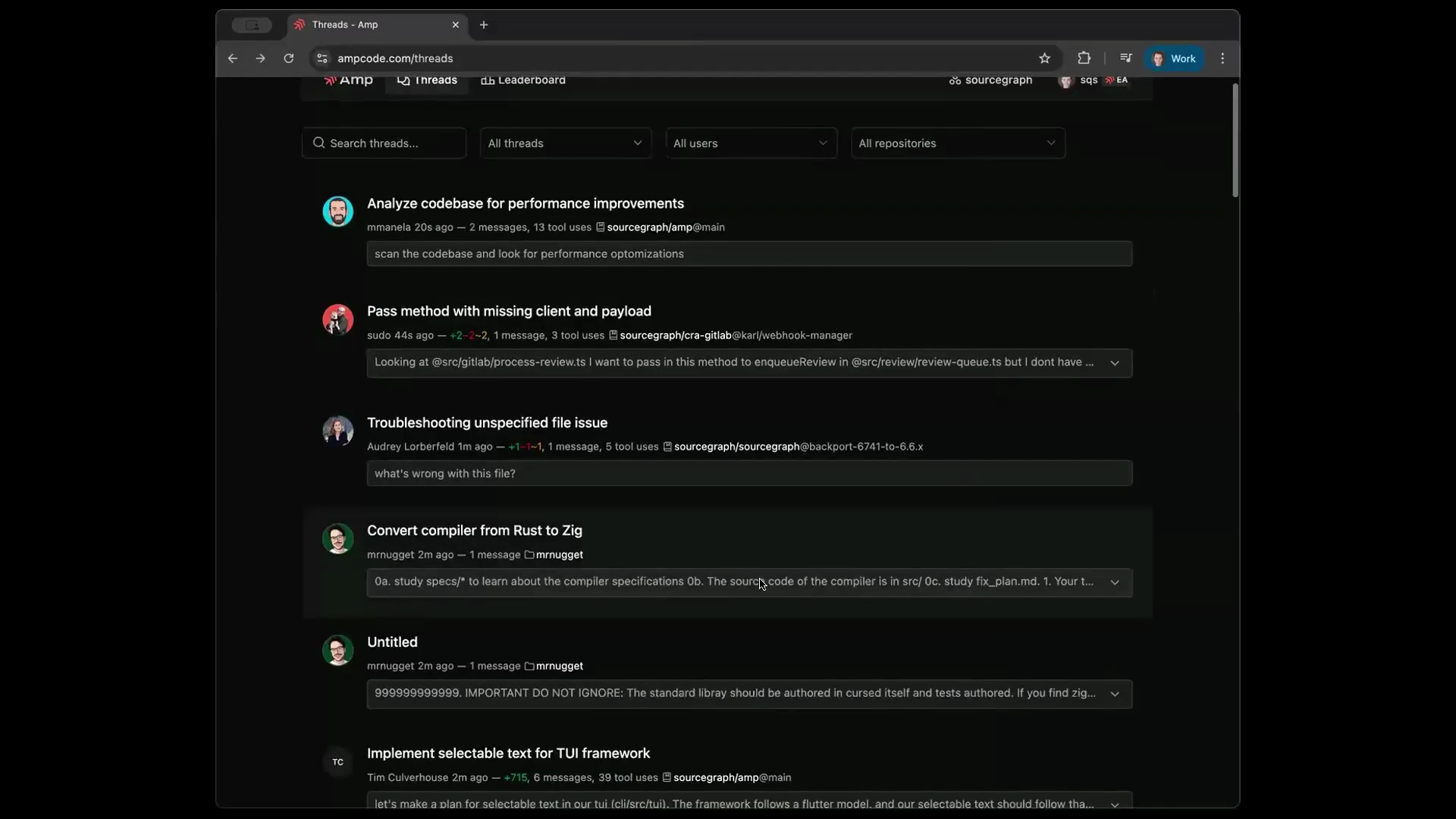
Quinn noted that Cursor and Claude Code lack native collaboration. Bolt-ons exist, but they are not integrated. Amp is the only tool I know that builds it in.
Real-World Performance
I tested Amp against Claude Code. I prompted both to build and deploy a simple application. I evaluated them on memory provisioning, health checks, and CI/CD integration, not just basic functionality. I shared my results with Quinn.
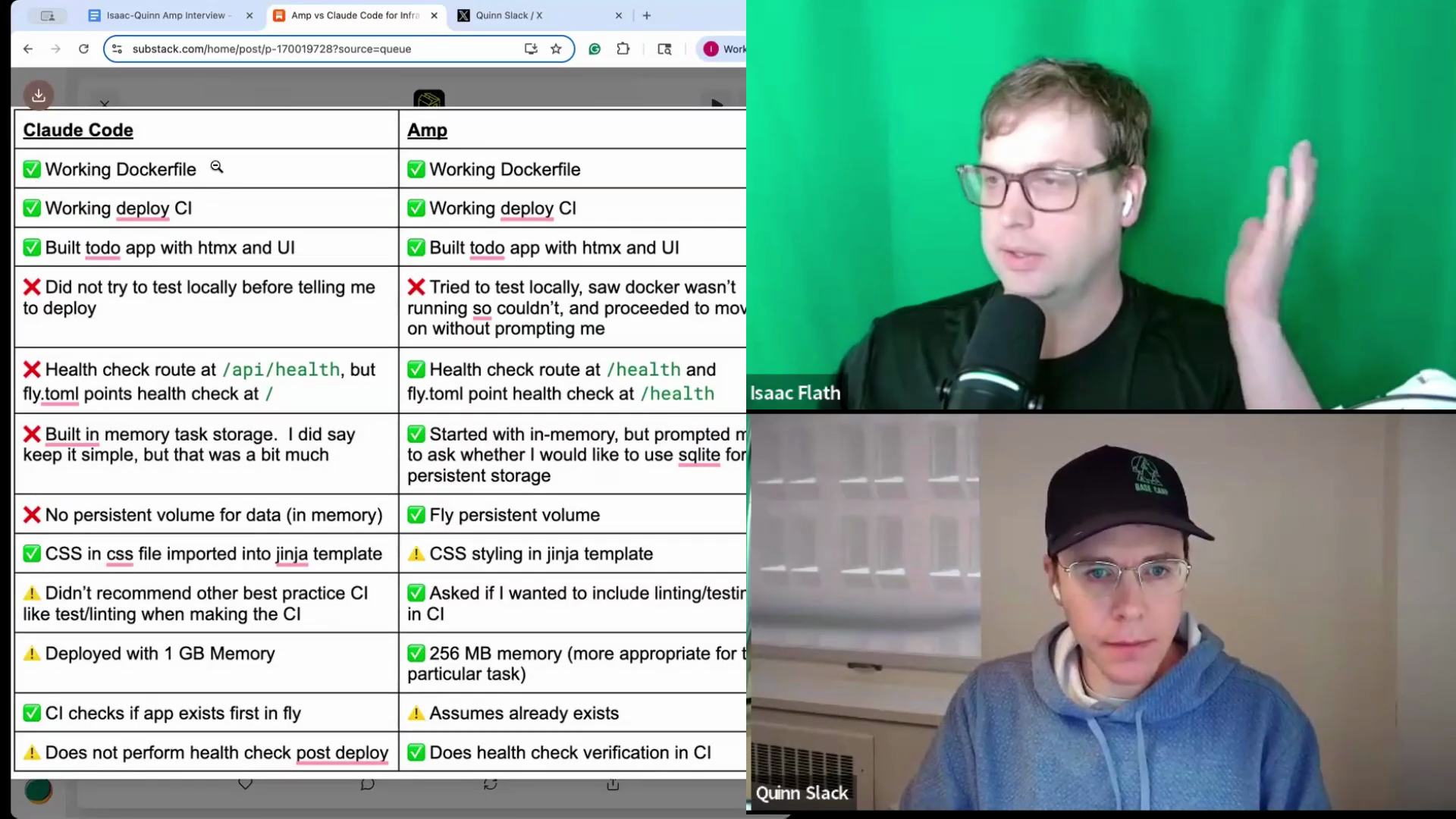
Both tools completed the task, but Amp Code provided a better developer experience.
My full analysis of the task, prompt, and results is available here.
Future Development
"Everything is changing" - Quinn [37:16]
Quinn believes "everything is changing" [37:16], so Amp Code avoids a fixed roadmap.
Instead, the team focuses on key areas:
- Integrating GPT-5 [37:31] and tracking other new models [37:58].
- I hope they add PDF support.
- They will continue integrating and evaluating new models.
Practical tips
Quinn offered several practical tips:
- Start with the $10 free tier.
- You control spending, as auto-reloading credits is off by default.
- For tricky tasks, ask for the Oracle model directly.
- Power users often edit their initial prompt for clarity instead of continuing the chat.